
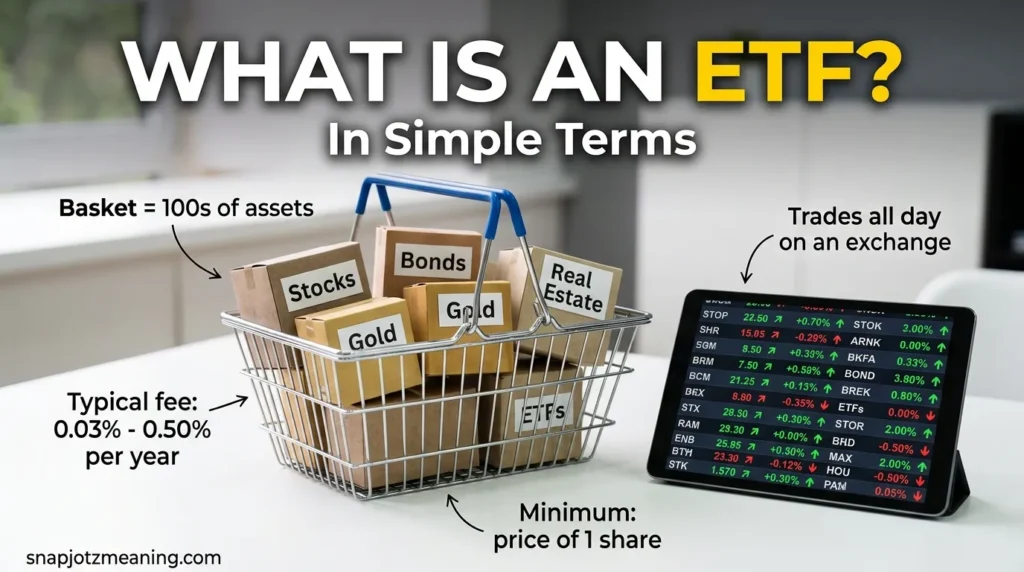
What is an ETF meaning in simple terms? An exchange-traded fund (ETF) is a basket of investments that you buy and sell on a stock exchange, just like a single stock. One share gives you a small piece of many companies, bonds, or assets at once.
This guide covers how ETFs work, the top 5 ETFs to buy, ETF vs stock, the risks, and the 7% rule. It is general education, not financial advice.
Table of Contents
What Is an ETF in Simple Terms?
Think of a fruit basket. You could buy apples, grapes, and pears one by one. Or you could buy one basket that holds all of them. An ETF is that basket for your money.
Most ETFs follow an index, like the S&P 500. The fund holds the same stocks as the index, so its ETF price moves with the market. The price changes all day while the market is open.
Here is what makes ETF investing different:
- ETF vs mutual fund: ETFs trade all day at market prices. Mutual funds trade once a day at one price, as Schwab explains.
- Safety rules: In the U.S., an ETF must register with the SEC, usually as an open-end fund, per Investor.gov.
- Types of ETFs: stock, bond, commodity, sector, international, dividend, inverse, and leveraged funds.
- Cost: The expense ratio is the yearly fee. Schwab reports that the asset-weighted average for passive ETFs is 0.14%.
There is also a behind-the-scenes step most guides skip. Large firms called authorized participants create and redeem ETF shares in big blocks, often 50,000 shares, according to Wikipedia. This keeps the ETF price close to its net asset value (NAV).
ETFs are also huge. Wikipedia notes the first U.S. ETF launched in January 1993. Today, U.S. equity ETFs hold about $10.2 trillion.
What Are the Top 5 ETFs to Buy?
There is no single best ETF. Good ones share a few traits: a low expense ratio, high trading volume, a tight bid-ask spread, and a clear index.
These five are widely held U.S. examples:
| Ticker | What it tracks | Best for |
|---|---|---|
| VOO | S&P 500, 500 large U.S. companies | Core long-term holding |
| VTI | Total U.S. stock market | Broadest stock exposure |
| QQQ | Nasdaq-100, tech-heavy | Growth seekers |
| SCHD | U.S. dividend-paying stocks | Income investors |
| BND | U.S. investment-grade bonds | Lower-risk balance |
VOO and VTI cover the broad market. QQQ leans toward technology, so it can swing more. SCHD focuses on dividends. BND adds bonds to calm a portfolio.
Check each fund’s current expense ratio and holdings on the issuer’s website before you buy.

Is an ETF Better Than a Stock?
Is ETF better than stock? It depends on your goal. An ETF spreads your money across many holdings. A stock puts it in one company.
Here is how they compare:
- Risk: One ETF holds many companies, so one bad stock hurts less. A single stock can drop hard.
- Effort: ETFs need little research. Stocks need you to study each company.
- Upside: A single stock can beat the market, but it can also fall far below it. An index ETF aims to match the market.
- Cost: Most U.S. brokers now charge $0 to trade listed ETFs and stocks online. ETFs add a small yearly expense ratio.
Many people hold both. They use ETFs as the core and add a few stocks on top.
Understanding ETFs can help you make smarter financial decisions, but investing is also about recognizing unexpected opportunities and appreciating the value of chance. This idea connects beautifully with the concept of serendipity and its meaning, which explores how fortunate discoveries and unexpected moments can bring surprising value to our lives.
Is an ETF a Good Investment, and Is Buying an ETF Risky?
Is ETF a good investment? For many long-term investors, yes. ETFs offer diversification, low costs, liquidity, and daily transparency. Wikipedia also notes they can be more tax-friendly than mutual funds, since investors usually owe capital gains tax only when they sell their own shares.
Is buying an ETF risky? Yes, all investing has risk. Diversifying does not guarantee a profit or prevent losses in a falling market.
Watch for these ETF risks:
- Market risk: If the index falls, the ETF falls with it.
- Tracking error: The ETF may drift slightly from its index.
- Wide spreads: Thinly traded ETFs can cost more to buy and sell.
- Premium or discount: The price can sit above or below NAV.
- Complex funds: Leveraged and inverse ETFs reset daily and are built for short-term use.
What is the 7% rule in ETF? It is a personal stop-loss guideline. If an ETF drops about 7% to 8% below your buy price, you review the position and decide whether to sell. Investor William O’Neil helped popularize this idea. It is a discipline tool, not an official rule, and it does not guarantee results.
How do you buy an ETF? Open a brokerage account, fund it, search the ticker, and place an order during market hours. Many investors buy a set amount each month.
FAQs
Are ETFs safe for beginners?
They can be a smart start because they spread risk. They are not risk-free, and prices can fall.
Can I invest in ETFs with a small amount?
Yes. You can start with the price of one share. Many brokers also offer fractional shares.
Do ETFs pay dividends?
Yes, if the stocks inside pay them. The fund passes the cash to you or reinvests it.
How do ETFs make money?
You earn when the price rises, and when the fund pays dividends or bond interest.
How are ETFs taxed in the U.S.?
You owe tax on dividends and on gains when you sell. Holding longer than a year usually lowers the tax rate. Ask a tax professional about your case.
Are ETFs better than mutual funds?
Often they cost less and trade more easily. Mutual funds can suit people who want automatic plans or hands-on management.
An ETF is a simple, low-cost way to own many investments in one trade. Start with a broad fund, mind the risks, and invest for the long term. Always check current fees and holdings, and talk to a licensed advisor if you need personal advice.
conclusion
An ETF is a simple, low-cost, flexible way to invest in a broad set of assets without picking individual securities. The trade-offs are that you still carry market risk, some niche ETFs are costly or volatile, and trading costs or spreads can apply. This is general information, not financial advice, so check the fees and holdings of any specific ETF before investing.
If you meant a different ETF (for example, Electron Transfer Flavoprotein in biology, or a country-specific “Education Trust Fund”), or you need a conclusion for an essay or report on ETFs, let me know and I’ll tailor it

Abroy Ahad is a word-meaning and language enthusiast dedicated to making confusing words, phrases, slang, and everyday expressions easier to understand. Through SnapJotzMeaning.com, he creates clear, simple, and practical explanations that help readers quickly discover what words mean and how they are commonly used.