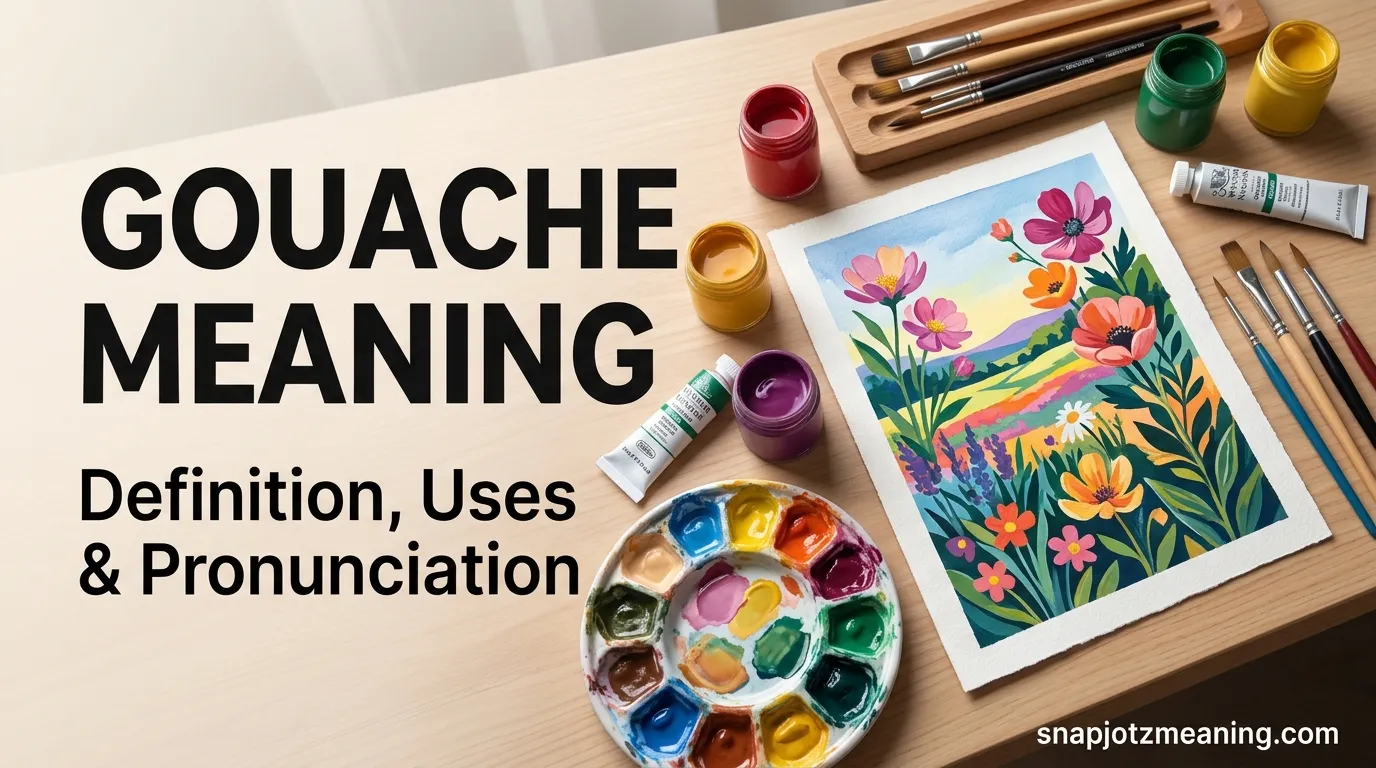
Gouache meaning is an opaque, water-based paint. It is made from pigment, water and a binder, usually gum arabic. Artists use it for posters, illustrations, comics and fine art.
If you searched for the gouache meaning, you probably want a simple answer. You also may be wondering how to say it, or whether it’s the same as gauche. This guide covers all of that in plain words.
Table of Contents
What Does Gouache Meaning?
The gouache definition is simple. It is a painting method that uses opaque watercolor. The word also names the paint itself and the finished painting.

Dictionary.com lists three senses of the word:
- The technique of painting with opaque watercolors
- The paint used in that technique
- A work painted with it
So you can say “I’m using gouache paint,” or “I bought a gouache at the gallery.”
How is gouache pronounced? Say it like “gwash.” Some people say “goo-ahsh.” Both are common in the US. Think of the first part as “gwa,” like the start of “Guam.”
Where the word comes from

The word has a watery history. English borrowed it from French, which took it from the Italian word guazzo. Merriam-Webster says that traces back to the Latin aquatio, meaning “watering place,” from aqua, meaning water. Its first known use in English was in 1882.
Guazzo also meant “mud” or “puddle.” That fits, since the paint is thick and creamy.
What is gouache made of?
Gouache has four main parts:
- Natural pigment
- Water
- A binder, such as gum arabic or dextrin
- Chalk or a white filler, which adds body
Wikipedia notes that gouache has bigger pigment particles than watercolor. It also has more pigment compared to binder. That is why it covers so well and looks heavy and flat.
How old is gouache?
Very old. Wikipedia says gouache has been used for at least twelve centuries. Early forms appeared in Ancient Egyptian painting. Artists also used it in European illuminated manuscripts and in Persian and Mughal miniatures.
Tate says the term was first used in France in the eighteenth century. In the 1800s, the paint tube made it easier to use. Zinc oxide, called Chinese white, also replaced lead white.
Later, many animators used gouache to color cels. Henri Matisse used it for his famous cut-out works. J. M. W. Turner used it too.
What is another word for gouache?
What is another word for gouache? The closest ones are:
- Body color (or bodycolour)
- Opaque watercolor
- Poster paint (a close match, often a cheaper dextrin-based version)
Tate adds that people now use “gouache” loosely for any drawing done in body color. So the word has a wide meaning in art circles.
What does it mean to call someone gouache?
It doesn’t mean anything. Gouache is a word for paint, not for people. Nobody uses it as an insult or a personality label.
If you heard it used about a person, the speaker almost certainly meant gauche. That is a different word. We’ll cover it below.
Gouache vs Watercolor and Acrylic
These three paints look alike at first. They all mix with water, at least when wet. But they act very differently once they hit the paper.
What is the difference between gouache and watercolor? The big one is opacity. Watercolor is see-through. Light passes through it and bounces off the white paper. Gouache is opaque. It covers the paper, so the white does not show through.
That changes how you paint:
- With watercolor, you start light and build darker.
- With gouache, you can paint light colors over dark ones.
- Gouache lets you fix mistakes by painting over them.
- Gouache is great for flat, bold color and crisp shapes.
Gouache also dries to a matte finish. Wikipedia points out one tricky thing. Colors often shift as they dry. Light tones tend to dry darker, and dark tones tend to dry lighter. That makes it hard to match a color from one day to the next.
Another plus is that gouache can be rewetted. Add water to dried paint and it comes back to life.
Are gouache and acrylic the same? No. They look similar because both can be opaque. But they behave differently.
- Gouache stays water-soluble after it dries. Acrylic turns water-resistant.
- Gouache dries matte. Acrylic often dries with a slight sheen.
- Gouache can crack if you layer it too thick on a flexible surface.
- Acrylic is more durable and forgiving on many surfaces.
There is also acrylic gouache. Wikipedia describes it as a newer paint with a highly concentrated pigment and an acrylic binder. It dries matte, opaque and water-resistant. It sits between the two worlds.
Here is a quick side-by-side look:
| Feature | Gouache | Watercolor | Acrylic |
|---|---|---|---|
| Opacity | Opaque | Translucent | Opaque |
| Finish | Matte | Soft, transparent | Satin or glossy |
| Rewettable | Yes | Yes | No |
| Water-resistant when dry | No | No | Yes |
| Best for | Flat color, posters, illustration | Washes, light landscapes | Canvas, murals, bold work |
A few simple tips if you’re new:
- Use watercolor paper or a heavy sketch paper.
- Mix with only a little water for creamy coverage.
- Test your color on scrap paper first, since it shifts as it dries.
- Keep your layers thin to avoid cracks.
Gouache vs Gauche: Does Gauche Mean Vulgar?
Many people mix these words up. They sound different, mean different things and have different roots. This section clears it up.
Gauche is an adjective. It means awkward, clumsy or lacking social polish. It comes from the French word for “left.” Say it like “gohsh.”
So someone might be called gauche for blurting out a rude remark at a quiet dinner. Or for wearing a flashy outfit to a very formal event.
Does gauche mean vulgar? Not exactly. Gauche is mostly about being socially awkward or tactless. Vulgar is stronger and means crude or offensive. The two can overlap, since a gauche act can feel crude. But a gauche person is usually just unpolished, not rude on purpose.
Here is the easy way to tell them apart:
- Gouache (gwash) is a paint.
- Gauche (gohsh) is a word for awkward or tactless behavior.
One more tip. If you want to say something is a paint, use gouache. If you want to describe awkward manners, use gauche. That clears up the question about what it means to call someone gouache. The right word was gauche all along.
Just as understanding gouache helps you explore the world of art with confidence, learning about body-related terms can help you better understand everyday language and health discussions. If you’ve come across the term FUPA and wondered what it means, explore this guide to the meaning of FUPA and safe ways to reduce lower abdominal fat for a clear, practical explanation.
FAQs
What does it mean to call someone gouache?
It doesn’t mean anything. Gouache is a word for paint, not for people. Most people who say it about someone mean gauche, which describes awkward or tactless behavior. If you want to describe a person’s manners, gauche is the right word.
What is the difference between gouache and watercolor?
Gouache is opaque, so it covers the paper and hides what’s under it. Watercolor is translucent, so the white of the paper shows through. Gouache also has more pigment and a thicker body. It dries to a flat, matte finish, while watercolor looks soft and see-through.
Are gouache and acrylic the same?
No. Both can look opaque, but they act differently once dry. Gouache stays water-soluble, so you can rewet it and move it around. Acrylic turns water-resistant and stays put. There is also acrylic gouache, which sits between the two. It dries matte but is also water-resistant.
Say it like “gwash.” Some people say “goo-ahsh,” and both are fine. The word comes from French. Don’t mix it up with gauche, which sounds like “gohsh.”
Does gauche mean vulgar?
Not exactly. Gauche means awkward, clumsy or lacking social polish. Vulgar is stronger and means crude or offensive. A gauche remark can feel rude, but the person is usually just unpolished and not trying to offend.
What is another word for gouache?
The closest matches are body color (or bodycolour) and opaque watercolor. Poster paint is a close cousin, though it is often a cheaper, dextrin-based version. In art circles, people also use “gouache” loosely for any work done in body color.
Conclusion
The gouache meaning is simple. It is an opaque, water-based paint that dries to a flat, matte finish. The word can also mean a painting made with it.
Gouache covers the paper, so it differs from watercolor. It stays water-soluble, so it differs from acrylic. And it is not the same as gauche, which describes awkward manners.
Now you can answer “what is gouache?” with confidence. You also know how to say it: “gwash.”

Abroy Ahad is a word-meaning and language enthusiast dedicated to making confusing words, phrases, slang, and everyday expressions easier to understand. Through SnapJotzMeaning.com, he creates clear, simple, and practical explanations that help readers quickly discover what words mean and how they are commonly used.